RFID Readers in 2026: What UK Warehouses and Retailers Need to Know
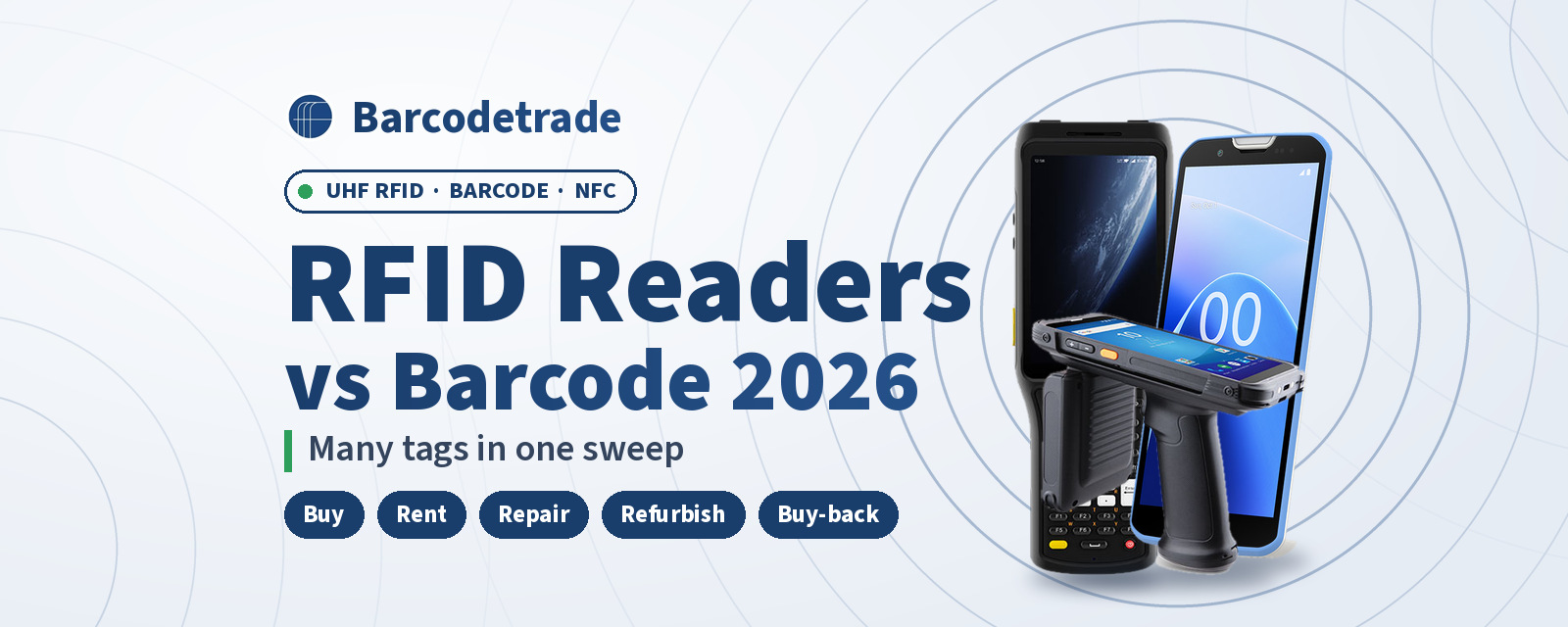
RFID is no longer a pilot project on the edge of the warehouse. The latest industry news shows RFID readers moving into the core of everyday operations: tunnels built to fit over conveyors that are already running, parcels tagged at the packing station so they are read automatically on collection, and item-level tagging in fresh food departments. For UK operations teams, the question has changed from "should we use RFID?" to "where does an RFID reader add value alongside our barcode scanners, and which devices should we choose?"
This guide explains how RFID works, how it compares with barcode scanning, which RFID readers suit which jobs, and how to build an RFID-ready fleet that is reliable, secure and sustainable.
RFID in the latest industry news: what is changing
Four developments stand out from the latest barcode and RFID industry news:
RFID verification without stopping the line. New RFID tunnels are designed to fit over existing conveyors in working distribution centres. Removing the need to modify or shut down a conveyor takes away one of the biggest barriers to RFID at goods-in and despatch.
Tagging moves upstream to the packing station. A major parcel network is extending RFID labelling to its shippers' own sites, so each parcel is read automatically when it is loaded, with no manual scan. The aim is fewer missed collections and fewer misloads.
Item-level RFID reaches fresh food. Grocery pilots now tag individual bakery and fresh items, reporting faster stock counts and lower shrink. These environments are harder than clothing: moisture, cold and packaging all affect how well a tag reads.
Label software is adding RFID encoding. The latest barcode labelling software includes RFID label templates alongside expanded 2D barcode support, so barcode and RFID labels can be designed and encoded in the same workflow.
At the same time, retail packaging is moving to 2D barcodes that carry batch and expiry data. RFID is not replacing the barcode. The two technologies are converging, and the hardware decisions you make now need to support both.
What is RFID and how does an RFID reader work?
RFID stands for radio frequency identification. An RFID tag is a small chip joined to an antenna, usually built into a label, card or hard tag. An RFID reader sends out a radio signal. A passive tag, which has no battery, uses the energy from that signal to power its chip and reply with its identity and any stored data. The reader then passes that data to your warehouse management system (WMS), enterprise resource planning (ERP) system or inventory application.
The main RFID frequency types
UHF (ultra-high frequency) passive RFID. This is the type used in warehousing, retail and logistics. In Europe, UHF RFID operates in the 865 to 868 MHz band. It reads at range and can read many tags in one sweep, which makes it ideal for stock counts, goods-in and asset tracking.
HF (high frequency) and NFC. These operate at 13.56 MHz and read at very short range. They suit access cards, authentication and tap-to-pair tasks, rather than bulk inventory.
When people search for an RFID scanner for business use, they almost always need a UHF RFID reader.
RFID vs barcode: replacement or partner?
Barcode scanning | UHF RFID | |
|---|---|---|
Line of sight | Needed. The scanner must see the code | Not needed. Tags read through cartons and packaging |
Reads per trigger pull | One code at a time | Many tags in one sweep |
Read range | Close range to long range, depending on the scan engine | From close range to many metres, depending on the reader |
Data | 1D codes carry an identifier; 2D codes carry more data, such as batch and expiry | Unique identity for every item, with optional user memory |
Best for | Point of sale, picking, item-level checks | Stock counts, receiving, despatch checks, asset tracking |
In practice, the strongest operations use both. Barcodes remain the universal language on pack and at the till. RFID adds speed and visibility where you need to count or verify many items at once. That is why the most useful RFID readers for enterprise teams are rugged Android mobile computers that combine UHF RFID with a 2D barcode scanner in one device.
Choosing an RFID reader: handheld, pistol grip or fixed
Handheld RFID mobile computers
Barcodetrade supplies Chainway handheld devices that combine UHF RFID with barcode scanning on Android:
Chainway C60: a compact Android device with a numeric keypad, UHF RFID with a read range of up to 13 m and 2D barcode scanning, with IP65 sealing. Other C60 configurations offer an aluminium-alloy body, a pistol grip and optional UHF.
Chainway C61: an industrial-grade device with a 37-key keyboard, UHF RFID with a 15 to 25 m range, 2D barcode scanning, a hot-swappable battery and 1.8 m drop resistance.
Chainway C66: a 5.5-inch Android handheld with UHF RFID for close-range reading, barcode scanning, NFC and Wi-Fi 6.
Chainway C71: includes a high-performance UHF RFID model with a read range of up to 30 m, an IP67 rating, 1.5 m drop resistance and barcode and NFC support, plus a model focused on barcode versatility for extended outdoor use.
As a rule of thumb, choose shorter-range readers for item-level work, such as shelf checks and tagged assets in a small area. Choose long-range, pistol-grip readers for high racking, yards and fast cycle counts across large zones.
RFID in healthcare and clinical settings
The CipherLab RS38H integrates barcoding, RFID, OCR and mobile computing in a purpose-built device for clinical workers, with a disinfectant-ready housing designed to withstand frequent cleaning.
RFID label printers
Tags have to be encoded before they can be read. Barcodetrade services desktop, mobile and industrial label printers across thermal, thermal transfer and RFID technologies, covering all major brands, including Zebra and Honeywell.
Fixed readers, antennas and portals
Fixed readers, antennas and portals sit at dock doors, conveyors and gateways to capture tags automatically as goods move. They work best alongside handheld RFID readers, which find the exceptions.
Five practical checks before you roll out RFID scanners
Start with the process, not the tag. Map exactly where items are counted, received, picked and despatched. Put RFID where many items move together or need counting often, and keep barcode scanning where single-item accuracy matters most.
Test tags on your real products. Metal, liquids and dense packaging all affect UHF performance. Trial several tag designs and placements on real stock before you commit to a tag specification.
Control the read zone. Long range is an advantage until a reader picks up tags from the next aisle or the next pallet. Adjust reader power and antenna placement so that reads are captured only where you intend.
Keep barcode as the fallback. Choose RFID readers with integrated 2D barcode scanning. If a tag is damaged or missing, the operator can still scan the barcode, and the same device is ready for 2D barcodes on pack.
Plan the device lifecycle. Standardise operating system versions, security patches and device management configuration across the fleet. Decide at the start how devices will be repaired, refreshed and retired.
Sustainable RFID: extend the life of every reader
Around 80% of a device's lifetime CO₂ emissions come from manufacturing. That is why extending the working life of RFID readers, mobile computers and label printers through repair and refurbishment is one of the most effective sustainability decisions an operations team can make.
Barcodetrade has saved 950,000+ devices from landfill, preventing 350,000 kg of CO₂e. Choosing refurbished equipment saves 77 to 91% of CO₂ emissions compared with buying new. To see the impact of your own fleet, use our CO₂ calculator.
How Barcodetrade supports RFID and barcode fleets
Barcodetrade, the trading name of Fala Limited, was founded in 2005 and supports enterprise barcode, RFID and POS technology from its UK service centre in Farnborough.
Repair: our repair tokens cover RFID readers and equipment, as well as handheld barcode scanners, mobile computers, printers and POS systems, across all major brands. See all repair services.
Mobile computers: component-level repair and refurbishment for Android, Windows CE/Mobile and legacy platforms, including Zebra, Honeywell, Datalogic and Intermec devices, with OS updates, security patches and custom imaging.
Refurbishment: professional reconditioning to extend the life of your existing fleet.
Rentals: pre-configured barcode scanners, label printers, mobile computers and selected RFID readers for warehouse spikes, retail surges and end-of-year stock counts.
Buy-back: we buy RFID equipment, including fixed and handheld readers, antennas and portals, plus mobile and RFID printers.
ITAD: responsible disposal and recycling of retired RFID readers, scanners and mobile computers, with certified data destruction.
Choosing barcode hardware as well? Our barcode scanner buying guide explains the main options.
Frequently asked questions
What is RFID?
RFID (radio frequency identification) is a way to identify items using radio waves. A reader sends out a signal, and a tag on the item replies with its unique identity. Unlike a barcode, the tag does not need to be in the reader's line of sight.
What does RFID stand for?
RFID stands for radio frequency identification.
How does RFID work?
An RFID reader emits a radio signal through its antenna. A passive tag uses the energy from that signal to power its chip and send back its stored identity. The reader passes the data to your inventory, warehouse or asset system.
What is an RFID tag?
An RFID tag is a small chip joined to an antenna, usually built into a label, card or hard tag. Passive UHF tags have no battery and are used for stock, cartons, pallets and assets.
What is an RFID scanner?
An RFID scanner, also called an RFID reader, is a device that reads RFID tags. For business use, the most practical choice is a rugged handheld mobile computer that combines a UHF RFID reader with a 2D barcode scanner, such as the Chainway C60, C61 or C71.
What is the difference between RFID and a barcode?
A barcode must be seen by the scanner and is read one code at a time. RFID tags can be read without line of sight, and many tags can be read in one sweep. Most operations use both: barcodes on pack and at the till, and RFID for counting, receiving and tracking.
Can Barcodetrade repair RFID readers?
Yes. Barcodetrade's repair tokens cover RFID readers and equipment across all major brands, alongside barcode scanners, mobile computers, printers and POS systems.
Talk to our team
To plan an RFID reader rollout, or to repair, refurbish or retire your existing RFID and barcode fleet, call 01252 511409, email info@barcodetrade.co.uk or contact us online.
What is the first process in your operation that you would move to RFID?