1D vs 2D Barcode Scanners: Is Your Warehouse Fleet Ready for 2D Codes?
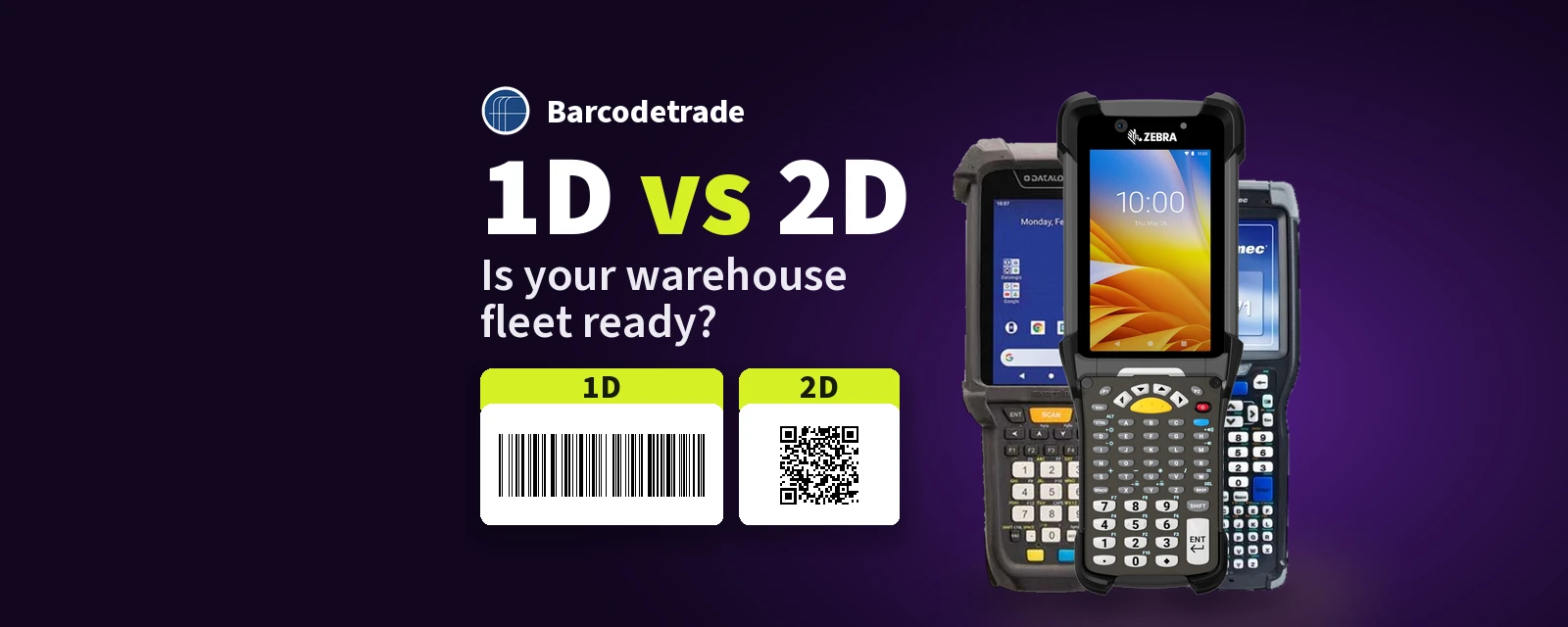
Warehouse teams still do most of their scanning with barcodes on labels: at goods-in, on the pick face, at packing and at dispatch. Many of those labels still carry a linear barcode. A growing number also carry a 2D barcode, such as a QR code or a Data Matrix, which can hold more information in less space.
A 1D laser scanner is built to read linear barcodes. A 2D barcode scanner, also called a 2D imager, reads those linear barcodes and the 2D codes as well. If part of your fleet is 1D-only, those units will keep doing the linear work they were bought for, but they will not read a 2D code when one appears on a supplier label or a label you print yourself.
This guide explains the difference, how to check what your warehouse handhelds can already read, and what to do next. Keep capable devices in use, repair the ones that still have life in them, and add 2D imagers where the workflow needs them.
1D barcodes and 2D barcodes: what changes on the label
A 1D barcode is a linear code: a row of bars and spaces that carries an identifier, such as an item, carton or location code. This is still the format most warehouse labels use.
A 2D barcode is a matrix code. Instead of a single line of bars, it uses a pattern of modules, as you see on a QR code or a Data Matrix. Because the data sits in two dimensions, the symbol can carry more information in less space. That is why 2D codes are becoming more common on product labels, transport labels and mixed supplier formats.
Our barcode scanner buying guide covers the 1D or 2D choice in brief. This article looks at that choice in depth for warehouse fleets.
What is a 1D barcode scanner, and what is a 2D barcode scanner?
A 1D barcode scanner reads traditional linear barcodes only. On our Zebra scanners page, the Zebra LS2208 is the example of this type: it is a 1D laser, and a proven choice for simple workflows that only need to read linear codes.
A 2D barcode scanner is a 2D imager. It captures the symbol and decodes it, so it can read both linear barcodes and matrix codes, including QR codes. The Zebra DS2208 is the corded 2D imager on the same page, and the cordless Zebra DS2278 delivers the same scanning performance with Bluetooth connectivity.
That is the difference that matters on the warehouse floor:
A 1D laser reads a linear barcode. It cannot read a QR code or a Data Matrix.
A 2D imager reads the linear barcode and the 2D code on the same label.
Neither type is a poor scanner. They are built for different symbols. The risk is using a 1D-only device on a process that now includes 2D codes, and treating a failed scan as a hardware fault when the scanner is the wrong type for that symbol.
How to check what your warehouse fleet can read
Before you change anything, find out what is already in service. A check on a sample of devices from goods-in, picking and dispatch will show you the gap.
1. Test with both types of code. Use a clean linear barcode and a clean 2D code, such as a QR code or a Data Matrix. Scan both with each model. If a device reads the linear code and not the 2D code, it is 1D-only. If it reads both, it is a 2D barcode scanner or has a 2D scan engine.
2. Confirm the model. On the Zebra range we supply, the LS2208 is listed as a 1D laser and the DS2208 and DS2278 are listed as 2D imagers. The Zebra DS8178 is a cordless 2D scanner that reads 1D and 2D barcodes, including QR codes. If a unit is unlabelled, use the scan test.
3. Check mobile computers as well as handhelds. Include rugged handheld computers in the same test. Our mobile computer services cover devices with integrated scanning, including Zebra MC series, Honeywell Dolphin and CK series, and Datalogic Memor and Skorpio models.
4. Separate a type mismatch from a fault. A scanner that will not read may have a settings issue, a dirty or scratched window, a worn trigger or a failed scan engine. Our guide to a scanner that is not charging or not scanning covers the checks worth doing first. If the same device reads linear barcodes cleanly and only fails on 2D codes, the issue is the scanner type, not a repair.
Keep a list by model, area and result: reads linear only, reads both, or needs a fault check.
When a 1D scanner is still the right tool
A 1D laser scanner can still be the right device for a simple, fixed workflow, especially where barcode types are controlled internally. If a packing bench or a closed loop in your warehouse only ever presents linear barcodes, a working LS2208 or another 1D unit can stay in service.
If one of those scanners develops a fault, repair it rather than taking it out of service. Our repair team at the Farnborough service centre carries out expert Zebra, Honeywell and Datalogic repair, including scan engine and laser recalibration, trigger, keypad and casing work, mainboard diagnostics and battery work.
When a 2D barcode scanner is the better fit
A 2D imager is the more flexible choice when labels may include both formats: product labels, transport labels, QR codes, mixed supplier formats, or 2D codes you print yourself.
For warehouse work, these are the options we document on the site:
Standard warehouse use. The Zebra DS2278 wireless 2D scanner handles most requirements in a standard warehouse environment. The corded DS2208 is the matching 2D imager when a cable is acceptable.
Harsh or cold-storage conditions. The ruggedised Zebra DS3678 series, and the corded DS3608, are built for demanding warehouse and manufacturing environments, including cold storage.
Racking and rough handling. The Zebra DS3578 is a rugged cordless imager with extended range, built to read labels high on racking.
Hands-free picking and packing. The Zebra RS6000 is a wearable Bluetooth imager, worn on the finger so both hands stay free for picking, packing, sorting and loading.
Cordless 2D scanning. The Zebra DS8178 is a cordless 2D scanner that reads 1D and 2D barcodes, including QR codes, for teams that move as they scan.
We also support 2D barcode scanners and 1D units from Honeywell and Datalogic, alongside Zebra, through refurbished devices, rental and repair.
Labels, printers and the codes you ask scanners to read
A scanner can only read what the label presents clearly. If you are adding 2D codes to your own carton, location or shipping labels, the printer has to produce a symbol that a 2D imager can decode. Our guide to direct thermal vs thermal transfer notes that small or dense codes, including Data Matrix and QR, need enough resolution to print every module of the symbol.
Faded, scratched or poorly printed labels fail on any scanner. Our label printer services cover desktop and industrial printers, including printhead, sensor, belt, roller and platen repairs, and printer rental when you need extra capacity.
After the check: keep, repair, add 2D capacity and retire with care
Once you know what each model can read, plan the next step rather than clearing the fleet in one go.
Keep working 1D scanners on linear-only tasks. Move them to processes that will not present a 2D code, and keep a few as spares.
Repair devices that still have a role. If a 1D or 2D unit has a worn trigger, a tired battery, a scratched window or a scan engine that needs recalibrating, send it for expert repair. Call 01252 511409 or email info@barcodetrade.co.uk to request an RMA, then send the device to our Farnborough service centre.
Add 2D imagers where the workflow needs them. Put 2D barcode scanners on goods-in, returns, picking or dispatch if those areas now see QR codes, Data Matrix symbols or mixed supplier labels. Refurbished 2D imagers are on our Zebra scanners page, graded and tested in Farnborough.
Rent 2D barcode scanners when you need extra capacity. Our rentals include rugged, handheld and wireless 2D and 1D scanners from Zebra, Honeywell and Datalogic, pre-configured and tested before dispatch. Rental also suits a trial, a peak, or cover while a device is away for repair.
Sell or retire units you no longer need. When a 1D scanner is no longer required, or you are standardising on 2D imagers, use our buy-back programme. We buy surplus scanners, mobile computers and label printers, working or not, with secure data wiping. Devices beyond reuse go through ITAD as a last step, with certified data destruction and WEEE-compliant recycling.
The sustainability case for checking the fleet first
Most of a scanner's carbon footprint is created when it is manufactured, not while it is in use. Repairing a working device, and adding 2D imagers only where they are needed, avoids building a replacement for every unit. Through repair, refurbishment, rental, buy-back and responsible ITAD, Barcodetrade has saved 950,000+ devices from landfill and prevented 350,000 kg CO₂e. Use our CO₂ calculator.
Check your fleet, then decide with us
Barcodetrade has supported barcode scanners, mobile computers and label printers from Farnborough since 2005. If you are unsure whether your handhelds can read the 2D codes now appearing on warehouse labels, we can help you check the fleet, repair devices that should stay in service, and add 2D barcode scanners where needed.
Call 01252 511409, email info@barcodetrade.co.uk or contact us.
Frequently asked questions
What is the difference between a 1D and a 2D barcode scanner?
A 1D scanner, such as the Zebra LS2208, reads traditional linear barcodes only. A 2D barcode scanner, or 2D imager, such as the Zebra DS2208, reads both linear barcodes and matrix codes, including QR codes.
Can a 2D barcode scanner read 1D barcodes?
Yes. A 2D imager reads linear barcodes and 2D codes, including QR codes and Data Matrix symbols.
Can a 1D laser scanner read a QR code?
No. A 1D laser is built to read a linear barcode and cannot decode a QR code or a Data Matrix. Use a 2D imager for those symbols, and keep the 1D laser on linear-only work.
Which 2D barcode scanner is suitable for warehouse use?
For standard warehouse environments, the Zebra DS2278 wireless 2D scanner handles most requirements. Harsh conditions, including cold storage, benefit from the ruggedised DS3678 series. The DS3578 is a rugged cordless imager for racking, and the RS6000 is a wearable imager for picking and packing.
Do I need to replace my 1D scanners?
Not necessarily. If a 1D scanner still matches a linear-only process, keep it in service and repair it if it develops a fault. Add 2D imagers where 2D codes now appear, and use buy-back for units you no longer need.
Can I rent 2D barcode scanners?
Yes. We rent rugged, handheld and wireless 2D and 1D scanners from Zebra, Honeywell and Datalogic, pre-configured and tested before dispatch. Rental suits peaks, projects, trials and cover during a repair.