WEEE Recycling and Barcode Hardware: Sell or Reuse It Before You Recycle
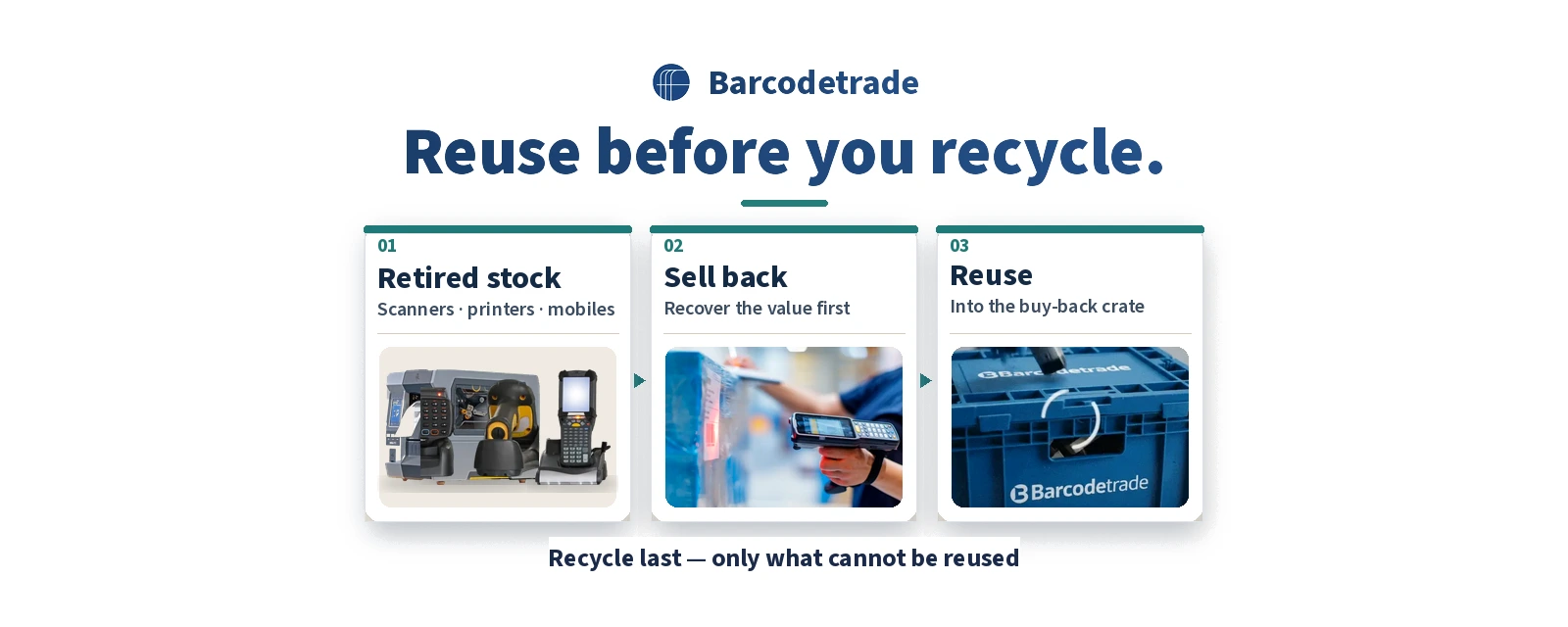
A cupboard of retired scanners is not waste. It is unrecovered value. When a barcode fleet is refreshed, the old barcode scanners, mobile computers, label printers, RFID readers and rugged tablets are too often boxed up and sent straight for WEEE recycling. Under the UK's WEEE rules, recycling is a legitimate end point, but it should be the last one. Most enterprise barcode hardware still works, still has a second-user market and can still be sold back, refurbished or redeployed. This guide explains what the WEEE regulations mean for businesses that use barcode hardware, how a buy-back programme recovers value from retired devices, and where secure IT asset disposal fits once every reuse option has been exhausted.
Why WEEE recycling is back on the agenda
WEEE (waste electrical and electronic equipment), commonly called e-waste, is one of the fastest-growing waste streams, and the UK compliance system around it is active again. Producers that place five tonnes or more of electrical equipment on the UK market a year must join a producer compliance scheme by 15 November for the following compliance year, so the deadline to join a scheme for 2027 is 15 November 2026. In October 2026, UK regulators approved a new WEEE producer compliance scheme for 2027, the first new entrant to that market in many years.
For most organisations running barcode fleets, these deadlines sit with the manufacturers and importers rather than with the end user. They are still a timely reminder for operations, IT and sustainability teams to ask a simple question before the next refresh: what happens to the devices we are taking out of service?
WEEE regulations UK: what they mean for barcode hardware users
The Waste Electrical and Electronic Equipment Regulations 2013 cover anything that depends on electric currents to work, which includes every scanner, mobile computer, label printer, RFID reader and tablet in your estate. In broad terms:
Producers (businesses that manufacture, import or rebrand electrical equipment for the UK market) must register, report the tonnage they place on the market and finance the collection and treatment of waste equipment. A business that imports equipment from overseas for its own use can also be treated as the producer of that equipment.
Business end users generate non-household WEEE when they retire devices. Their responsibility is to handle it properly under the waste duty of care: store it securely, pass it only to an authorised carrier and treatment route, and keep records of where it went.
Marking matters. Equipment carries the crossed-out wheeled bin symbol, which means it must never go into general waste.
The regulations themselves do not oblige you to recycle a device that still works. Reuse keeps equipment out of the waste stream altogether, and it is the outcome the wider waste hierarchy prefers. This is general guidance rather than legal advice, so confirm your own producer or waste obligations with the relevant UK environmental regulator.
Reuse before you recycle: the order that protects value
Barcodetrade runs a circular model for every device category it supports: sell, refurbish, rent, repair, buy back and, only at the very end, recycle. Applied to a fleet refresh, that gives a clear decision order:
Redeploy internally. Can the device move to another site, shift or lower-intensity task?
Repair. Is the fault economical to fix? Many retirements are caused by a worn trigger, battery, screen or printhead rather than a failed device.
Sell it back. If the device is surplus to your operation, a buy-back programme turns it into working capital and puts it back into service elsewhere.
Refurbish or rent. Restored devices can expand or renew a fleet, and rental units are returned, maintained and redeployed rather than retired.
IT asset disposal. Only when a device cannot be repaired, rented or refurbished should it move to certified data destruction and WEEE-compliant recycling.
Our existing guide to barcode hardware ITAD covers disposal and compliance in depth. This article focuses on step three, because it is the one most organisations skip.
Old barcode hardware still has value
Through our buy-back programme, Barcodetrade purchases surplus barcode and data capture equipment across all major manufacturers, in working or non-working condition:
Barcode scanners: handheld, presentation and industrial scanners, including laser and 2D imagers, wireless and fixed-mount models. We also support legacy and end-of-life models through our barcode scanner services.
Mobile computers: rugged handheld terminals, vehicle-mount computers and wearables. See our mobile computer services.
Label printers: desktop, industrial and mobile printers, thermal and thermal transfer, including RFID printers. See our label printer services.
RFID equipment: fixed and handheld readers, antennas and portals.
Rugged tablets: rugged and semi-rugged tablets used in warehouses, field service and retail management, covered by our rugged tablet services.
IT equipment: desktops, laptops, servers and monitors from enterprise environments.
A non-working unit is not automatically scrap. Devices that are beyond your own operational needs can be repaired, refurbished or harvested for compatible parts, which keeps other fleets running and reduces demand for new manufacturing.
How barcode scanner buy-back works
Selling used barcode scanners, mobile computers or printers back to Barcodetrade follows a simple five-step process:
Submit inventory. Share your equipment list with model details.
Receive valuation. We provide a free, no-obligation valuation at competitive market rates.
Accept the offer. You approve the valuation before anything moves.
Ship equipment. We arrange collection.
Receive payment. Payment is made through a secure process.
Every buy-back includes secure data wiping and certified data destruction, so the commercial decision never has to be traded off against information security.
Preparing a fleet for buy-back
The quality of your inventory decides the speed and accuracy of the valuation. Before you submit a list, enterprise teams should:
Build an asset register. Record manufacturer, model, serial number, site, condition and known faults for every unit.
Group by condition. Separate working, faulty and cosmetically worn devices. All three have value, but at different levels.
Keep accessories together. Batteries, cradles, chargers, holsters and power supplies add to a device's resale and reuse potential.
Release device management. Remove mobile computers and tablets from your device management platform and disable any factory reset protection tied to company accounts, so units can be wiped and re-imaged.
Record data-bearing devices. Flag every mobile computer, tablet and networked printer that has held Wi-Fi credentials, application data or user accounts, so the chain of custody is clear.
Check support status. If your fleet is approaching a manufacturer's end-of-support date, our guide to Zebra end of life in 2026 explains how to plan device-by-device decisions.
For larger estates, our scanner team also supports device estate audits, which give a clear picture of what should be repaired, redeployed, sold back or retired.
Data security comes first
Barcode hardware is frequently treated as operational equipment rather than IT equipment, yet mobile computers, tablets and networked printers can hold network credentials, application sessions and business records. Barcodetrade includes data sanitisation in its buy-back of scanners, label printers and tablets, and GDPR-compliant data destruction for mobile computers. Through our ITAD service, we provide certified data wiping or physical destruction and issue certificates of data destruction for your records.
Refurbish, redeploy or rent instead of buying new
Buy-back works in both directions. The devices you sell back can re-enter service, and the same lifecycle thinking can reduce what your next refresh needs to buy new:
Refurbishment follows a six-step process: complete assessment, detailed quote, component replacement with quality parts, deep cleaning, firmware and software updates, and comprehensive testing. Basic, Standard and Premium tiers match the level of work to the condition of each device.
Repair at our Farnborough service centre keeps trusted devices in service. Raise an RMA through our helpdesk to start.
Rentals cover peaks, projects and temporary sites with pre-configured barcode scanners, label printers, mobile computers and rugged tablets. Rental is circular by design: devices are returned, maintained and redeployed instead of sitting idle.
IT asset disposal: the final step
At Barcodetrade, ITAD is the last resort. A device moves to IT asset disposal only when it cannot be repaired because it is beyond economical repair, cannot be rented because it is an obsolete model with no rental demand, or cannot be refurbished because critical components have failed, and only if the customer still wants ITAD services.
When disposal is the right route, our six-step ITAD process covers asset collection with secure chain-of-custody protocols, inventory and audit by serial number and condition, certified data destruction, value assessment for residual resale or component recovery, responsible recycling under a zero-landfill policy, and certificates of disposal and data destruction. Our ITAD services are WEEE Directive compliant, and label printers that are beyond economic repair are recycled with WEEE-compliant documentation. That documentation is what your auditors, customers and sustainability team will ask for.
The sustainability case for reuse
Most of a barcode device's lifetime emissions are created when it is manufactured, which is why every device kept in service matters more than how it is eventually recycled. Through repair, refurbishment, rental, buy-back and responsible ITAD, Barcodetrade has saved more than 950,000 devices from landfill and prevented more than 350,000 kg CO₂e. Use our CO₂ calculator to estimate the impact of buying refurbished, repairing or renting barcode scanners, mobile computers and label printers, and use the result in your ESG reporting.
Frequently asked questions
Do the WEEE regulations apply to barcode scanners and mobile computers?
Yes. Barcode scanners, mobile computers, label printers, RFID readers and tablets are all electrical and electronic equipment under the UK WEEE regulations. When a business retires them, they must be reused or handled as non-household WEEE through an authorised route, never put into general waste.
Can I sell used barcode scanners that no longer work?
Yes. Barcodetrade's buy-back programme accepts working and non-working units. Faulty scanners, mobile computers, printers and tablets can still be repaired, refurbished or used for parts.
What barcode hardware does Barcodetrade buy back?
Barcode scanners, mobile computers, label printers, RFID readers and antennas, rugged tablets and enterprise IT equipment, across all major manufacturers.
Is data wiped before devices are resold?
Yes. Buy-back includes secure data wiping and certified data destruction. Through our ITAD service we provide certificates of data destruction for your records.
What is the difference between buy-back and IT asset disposal?
Buy-back recovers value from devices that can be reused. IT asset disposal is the last step for devices that cannot be repaired, rented or refurbished, combining certified data destruction, WEEE-compliant recycling under a zero-landfill policy and certificates of disposal.
How do I get a buy-back valuation?
Send your equipment list to info@barcodetrade.co.uk or call 01252 511409. Valuations are free and carry no obligation.
Talk to a buy-back specialist
Whether you are retiring a single site's scanners or an entire national fleet of mobile computers and label printers, our team will help you recover value, protect your data and keep reusable hardware out of the e-waste stream.
Call 01252 511409 or email info@barcodetrade.co.uk to request a free buy-back valuation today.
#Sustainability #CircularEconomy #EWaste #WEEE #ITAD #BuyBack